Göbekli Tepe
Discover the 11,500-year-old archaeological heritage that changed our understanding of human history, the origins of civilization, prehistoric beliefs and the extraordinary cultural richness of Southeastern Türkiye.
Imagine standing among enormous stone pillars built thousands of years before the Egyptian pyramids, Stonehenge and the first cities of Mesopotamia. Around you are stones decorated with carvings of foxes, snakes, wild boars, vultures and scorpions. The people who shaped these stones had no metal tools, no written language and no domesticated animals.
Welcome to Göbekli Tepe, one of the most important archaeological discoveries in human history.
Located approximately 15 kilometres northeast of Şanlıurfa city centre in southeastern Türkiye, Göbekli Tepe has fundamentally changed our understanding of prehistoric societies. Its monumental architecture demonstrates that hunter-gatherer communities were capable of organizing complex construction projects and creating sophisticated symbolic environments thousands of years before the emergence of urban civilizations.
Inscribed on the UNESCO World Heritage List in 2018, Göbekli Tepe is now considered one of the most significant archaeological sites in the world.
1. When Was Göbekli Tepe Built?
Göbekli Tepe primarily dates to the Pre-Pottery Neolithic period. Its earliest structures date to approximately 9600 BC, while different phases of activity continued until around 8200 BC.
This means that the earliest monumental structures at Göbekli Tepe were constructed approximately 11,500 years ago.
To understand just how extraordinary this is, consider the following historical comparisons: Monument or civilization Approximate date Göbekli Tepe 9600–8200 BC Early farming communities in the Near East 10th–9th millennium BC Early Mesopotamian cities 4th millennium BC Great Pyramid of Giza 26th century BC Stonehenge 3000–2000 BC
Göbekli Tepe is therefore thousands of years older than the famous monuments of ancient Egypt and prehistoric Britain.
Its chronology challenges traditional assumptions about the development of architecture, social organization and religious practices.
Göbekli Tepe was not constructed by an advanced urban civilization. Its builders belonged to communities that still depended largely on hunting and gathering.
2. The Discovery of Göbekli Tepe
Although Göbekli Tepe had been known to local communities for generations and recorded during archaeological surveys in the 1960s, its true significance remained unrecognized for many years.
In 1994, German archaeologist Klaus Schmidt began investigating the site. Excavations revealed monumental stone structures and enormous T-shaped limestone pillars.
What initially appeared to be an ordinary archaeological mound soon became one of the most important prehistoric discoveries of the twentieth century.
Schmidt and his team uncovered evidence of an architectural tradition that was far more sophisticated than previously expected from hunter-gatherer societies.
This discovery led archaeologists to reconsider the relationship between religion, social organization and the emergence of agriculture.
Göbekli Tepe was added to the UNESCO World Heritage List in 2018.
3. The Mysterious T-Shaped Stone Pillars
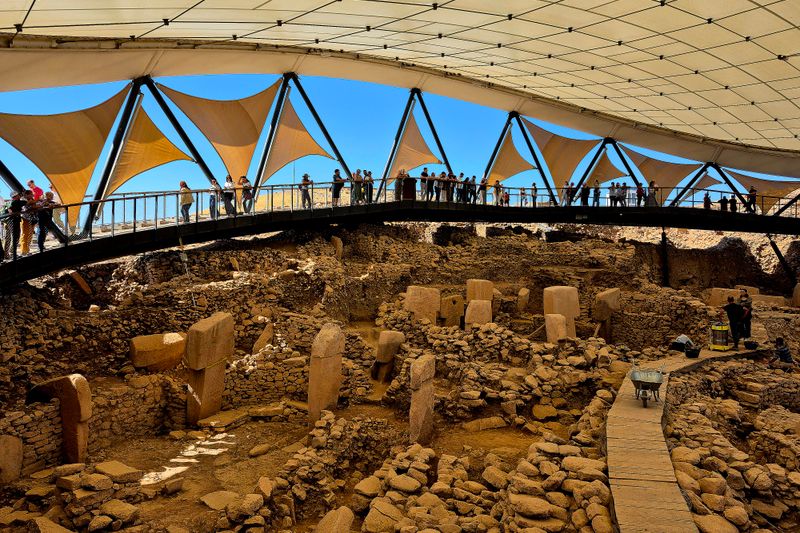
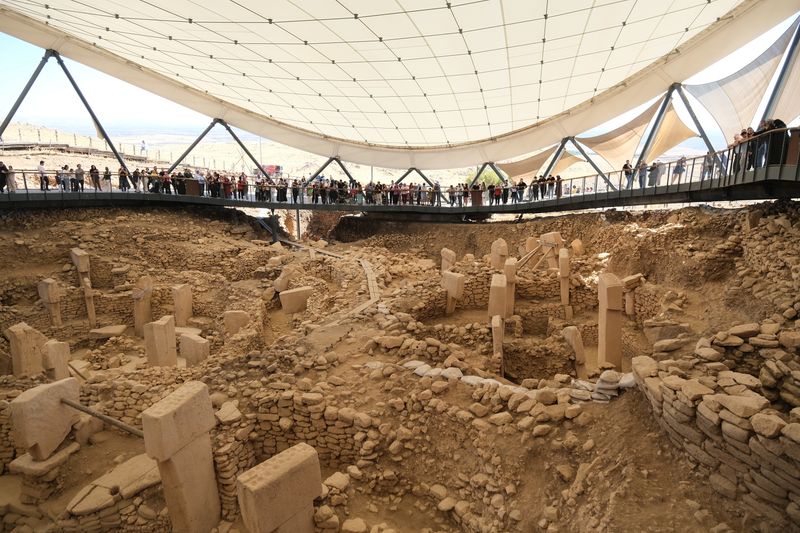
One of the most remarkable features of Göbekli Tepe is its enormous T-shaped limestone pillars.
Some of these pillars reach approximately 5.5 metres in height and weigh several tons.
Carved from the surrounding limestone bedrock, the pillars were carefully shaped and transported into monumental enclosures.
However, their significance goes far beyond their impressive size.
Some pillars feature representations of arms, hands, belts and loincloths. These details suggest that the pillars may represent highly stylized human figures.
Two particularly large pillars stand opposite each other in the centre of several enclosures. Their arrangement suggests that they may have represented important symbolic or supernatural beings.
However, their exact meaning remains unknown.
Did they represent ancestors? Did they symbolize supernatural beings? Or were they representations of important individuals within prehistoric communities?
Archaeologists have proposed different interpretations, but no definitive answer has yet been established.
4. Animal Reliefs: A Symbolic World of Prehistoric People
One of the most fascinating aspects of Göbekli Tepe is its extraordinary collection of animal carvings.
The stone pillars feature numerous wild animals, including:
- Foxes
- Snakes
- Wild boars
- Leopards
- Lions or other large felines
- Vultures
- Ducks and other birds
- Scorpions These animals were not simply decorative elements.
Their repeated appearance on different pillars suggests that they carried symbolic significance for the people who constructed the enclosures.
Some researchers interpret these representations as expressions of prehistoric beliefs about nature, human identity and the relationship between humans and animals.
The vulture imagery is particularly interesting. These representations have encouraged discussions about death, burial traditions and prehistoric practices involving human remains.
The animal carvings at Göbekli Tepe demonstrate that people living approximately 12,000 years ago were not simply concerned with survival. They also possessed a remarkably rich symbolic world.
5. Was Göbekli Tepe the World's First Temple?
Göbekli Tepe is frequently described as the world's oldest temple.
However, this description requires some explanation.
For many years, archaeologists believed that the monumental structures were primarily used for religious or ceremonial purposes.
Their impressive architecture, central pillars and symbolic decorations suggest that the site may have been used for communal rituals.
But what exactly happened inside these structures?
Possible activities include:
- Religious or ceremonial gatherings.
- Ritual feasts and communal celebrations.
- Activities associated with ancestors and death.
- Meetings between different hunter-gatherer groups.
- Events that strengthened social relationships and collective identity. UNESCO describes these monumental structures as communal buildings probably associated with social events and rituals.
Nevertheless, the precise function of each enclosure remains debated.
For this reason, it is scientifically more accurate to describe Göbekli Tepe as an early monumental ritual and communal complex rather than simply calling it a temple.
6. Did Religion Come Before Agriculture?
One of the most important questions raised by Göbekli Tepe concerns the relationship between religion and agriculture.
For many years, a traditional explanation of human development suggested that agriculture allowed people to settle permanently, produce food surpluses and eventually construct temples and monumental buildings.
Göbekli Tepe challenges this traditional model.
Its earliest monumental structures were built by communities that still relied heavily on hunting and gathering.
This raises an important question:
Could large-scale religious or ceremonial activities have encouraged people to cooperate, gather regularly and eventually develop more settled ways of life?
Some researchers have suggested that communal rituals and gatherings may have played an important role in creating the social conditions necessary for agricultural development.
However, Göbekli Tepe does not prove that religion directly caused agriculture.
The transition from hunting and gathering to farming was a long and complex process influenced by environmental, economic and social factors.
What Göbekli Tepe clearly demonstrates is that sophisticated symbolic culture and monumental architecture existed before fully developed agricultural societies.
7. How Did Prehistoric People Move Such Enormous Stones?
One of the most fascinating questions about Göbekli Tepe concerns its construction techniques.
How could prehistoric people move and position limestone pillars weighing several tons without metal tools, wheels or domesticated draft animals?
The answer lies in human cooperation, practical knowledge and an understanding of the local environment.
The builders used stone tools to extract and shape limestone from the surrounding bedrock.
The pillars were then prepared, transported and positioned through coordinated human effort.
Although the exact construction methods remain uncertain, archaeological evidence indicates that these communities possessed considerable technical knowledge.
Such an enormous project would have required:
- Skilled stoneworkers.
- Knowledge of limestone geology.
- Organized groups of workers.
- Planning and coordination.
- Shared social or ceremonial objectives. Göbekli Tepe demonstrates that complex construction projects did not necessarily require kings, states or highly developed urban societies.
Well-organized hunter-gatherer communities were also capable of creating extraordinary architectural achievements.
8. Why Was Göbekli Tepe Abandoned?
Another mystery surrounding Göbekli Tepe concerns the eventual abandonment of its monumental structures.
Archaeological evidence indicates that some enclosures were deliberately filled with stone fragments, soil and other materials.
For many years, this process was interpreted as intentional burial, possibly reflecting ritual practices.
However, the reasons behind these activities remain debated.
Changes in social organization, religious traditions, settlement patterns and environmental conditions may all have played a role.
Göbekli Tepe was not abandoned in a single moment. Its archaeological layers reveal a long history of construction, modification and changing uses.
These remains provide valuable evidence of how prehistoric communities interacted with their environment and transformed their social lives.
9. Göbekli Tepe and the Taş Tepeler Project
Göbekli Tepe is not an isolated prehistoric phenomenon.
It forms part of a much larger prehistoric cultural landscape in southeastern Türkiye.
The Taş Tepeler Project investigates several Neolithic archaeological sites in the Şanlıurfa region, helping researchers understand the communities that lived in Upper Mesopotamia during the transition towards settled life.
Some of the important archaeological sites include:
Karahan Tepe: An important Neolithic settlement featuring remarkable stone architecture and sculptural elements.
Sayburç: Known for its striking prehistoric human and animal representations.
Sefer Tepe: Another important archaeological site associated with the regional Neolithic tradition.
Nevali Çori: A significant early Neolithic settlement, now submerged beneath the waters of the Atatürk Dam reservoir.
Together, these sites reveal that the region was home to interconnected communities with sophisticated architectural, artistic and symbolic traditions.
The Taş Tepeler research programme is helping archaeologists move beyond the idea of Göbekli Tepe as a unique and isolated sanctuary.
Instead, Göbekli Tepe is increasingly understood as part of a much wider cultural transformation in prehistoric Upper Mesopotamia. 10. Is Southeastern Türkiye Safe to Visit? Discovering the Region Beyond Common Misconceptions One of the concerns that sometimes prevents international travellers from visiting Göbekli Tepe and Southeastern Türkiye is the region's geographical proximity to the Syrian border.
Unfortunately, some visitors associate this geographical proximity directly with security risks and decide to postpone or cancel their trips to Şanlıurfa, Mardin, Gaziantep, Diyarbakır and other fascinating destinations in the region.
We believe this perception deserves a more balanced perspective.
Southeastern Türkiye should not be judged solely by its geographical proximity to an international border.
This region is home to some of the world's most extraordinary historical monuments, ancient cities, archaeological discoveries, cultural traditions and culinary treasures.
Avoiding the entire region because of generalized fears may mean missing one of the most fascinating cultural experiences Türkiye has to offer.
It is also important to understand the broader social and economic impact of terrorism.
One of the objectives of terrorist organizations is to create an atmosphere of fear, discourage travel, damage tourism and negatively affect the economic and social lives of local communities.
When people abandon entire destinations because of fear, these organizations achieve part of their objective: preventing people from discovering different cultures, exploring new places and supporting local communities.
Of course, no destination in the world is completely free from risk. Minor criminal incidents and security-related problems can occur in any country or major city. Southeastern Türkiye is no exception.
However, it would be misleading to assume that every city in the region is dangerous simply because some areas are geographically close to Syria.
Our recommendation is to make travel decisions based on reliable and up-to-date security information rather than general assumptions or geographical perceptions. Visitors should consult their governments' official travel advisories, follow local authorities' announcements and respect any restrictions concerning specific border areas.
When planned responsibly, discovering Southeastern Türkiye can offer an unforgettable experience in terms of history, culture, hospitality and gastronomy.
From the historic streets of Mardin to the archaeological wonders of Göbekli Tepe, from the extraordinary cuisine of Gaziantep to the historic atmosphere of Şanlıurfa and Diyarbakır, this region offers experiences that are difficult to find elsewhere in the world.
Do not allow fear to prevent you from discovering one of the most beautiful and historically significant regions of Türkiye. Come and explore its history, meet its people, taste its cuisine and experience its extraordinary cultural heritage.
Southeastern Türkiye deserves to be discovered, understood and appreciated beyond headlines and misconceptions.
11. Visiting Göbekli Tepe Today
Today, Göbekli Tepe is one of Türkiye's most important archaeological destinations and a major attraction for visitors interested in history, archaeology and ancient civilizations.
Its location near Şanlıurfa makes it an essential stop on cultural journeys through Southeastern Türkiye.
- Location: Approximately 15 kilometres northeast of Şanlıurfa city centre.
- Recommended visit duration: Approximately 1.5–2 hours.
- Best time to visit: Spring and autumn, when temperatures are generally more comfortable. Nearby attractions worth visiting:
- Şanlıurfa Archaeology Museum
- Haleplibahçe Mosaic Museum
- Balıklıgöl
- Harran
- Karahan Tepe For travellers interested in archaeology, history and the origins of civilization, combining Göbekli Tepe with the Şanlıurfa Archaeology Museum and Karahan Tepe offers an especially rewarding cultural experience.
A Monument That Changed Our Understanding of Human History
Göbekli Tepe is much more than an archaeological site. It is a window into a period when human societies were experiencing one of the most important transformations in history.
Approximately 11,500 years ago, people without metal tools, writing systems or developed cities created monumental structures that continue to inspire wonder today.
They carved enormous limestone pillars, decorated them with sophisticated animal reliefs and organized communal activities on a scale that archaeologists once considered unlikely for hunter-gatherer societies.
Perhaps the greatest mystery of Göbekli Tepe is not how its builders moved the stones or carved the animals.
It is what motivated them to come together and create something so extraordinary.
Was it religion? A shared mythology? The need for social cooperation? Or a combination of all three?
We may never discover the complete answers.
But one thing is certain: Göbekli Tepe reminds us that the roots of human civilization are much older and more complex than we once imagined.
Southeastern Türkiye is a unique geographical region where this extraordinary historical heritage continues to exist alongside living cultures and traditions.
To understand the beginnings of civilization, we must look not only at the first cities and kingdoms, but also at the extraordinary people who built Göbekli Tepe.
And the best way to understand this heritage is to experience it firsthand.
Last Modification : 11/24/2026 8:03:31 AM