
History of Cappadocia
Cappadocia is one of the most fascinating historical regions in Turkey. Famous for its fairy chimneys, underground cities, ancient rock-cut churches, and breathtaking landscapes, Cappadocia has been home to numerous civilizations for thousands of years. Located in Central Anatolia, Cappadocia has witnessed the rise and fall of powerful empires, including the Hittites, Persians, Romans, and Byzantines. Each civilization left its mark on the region's architecture, culture, religion, and traditions. Today, visitors exploring Cappadocia can discover much more than its natural beauty. The region offers a remarkable journey through ancient Anatolian history, early Christianity, Byzantine art, and underground architecture. Let's explore the fascinating history of Cappadocia, from the Hittite civilization to the Roman and Byzantine periods.
1. Where Is Cappadocia and Why Is It Historically Important?
Cappadocia is located in Central Anatolia, in the heart of modern-day Turkey. The historical region covered a much larger area than today's popular tourist destination and included parts of Nevşehir, Kayseri, Aksaray, Niğde, and surrounding territories. Its geographical location made Cappadocia an important crossroads between Anatolia, Mesopotamia, and the Mediterranean world. Throughout history, the region became an important center for trade, military movements, agriculture, and cultural exchange. Cappadocia is also famous for its unique geological formations. Millions of years ago, volcanic eruptions from Mount Erciyes, Mount Hasan, and other volcanoes covered the region with layers of volcanic ash and rock. Over time, wind and water erosion shaped these soft volcanic formations into the spectacular fairy chimneys that visitors admire today. The soft volcanic rock also made it possible for ancient inhabitants to carve houses, churches, monasteries, storage rooms, and even entire underground settlements into the landscape.
2. The Hittites: One of the Earliest Great Civilizations of Cappadocia
The Hittites were one of the most powerful civilizations of ancient Anatolia. Their empire flourished mainly between approximately 1650 and 1200 BC, with its capital at Hattusa, located in modern-day Çorum, Turkey. Central Anatolia, including the wider Cappadocian region, was closely connected to the political and economic world of the Hittites. The Hittites developed an advanced civilization with a sophisticated political system, impressive architecture, agriculture, metalworking, and diplomatic relations with neighboring kingdoms.
Kültepe and the Assyrian Trade Colonies
One of the most important archaeological sites connected to the early history of Cappadocia is Kültepe, located near modern-day Kayseri. Known in antiquity as Kanesh or Kaniš, Kültepe was an important commercial center during the early second millennium BC. Assyrian merchants traveled from Mesopotamia to Anatolia and established trading settlements known as karums. They traded goods such as tin, textiles, and precious materials. Thousands of cuneiform tablets discovered at Kültepe provide valuable information about ancient commercial activities, family relationships, financial agreements, and daily life. These documents are particularly important because they represent some of the earliest written records discovered in Anatolia. The development of trade networks helped shape the economic and cultural environment in which the Hittite civilization later flourished.
3. The Persian Empire and the Kingdom of Cappadocia
Following the collapse of the Hittite Empire around 1200 BC, Anatolia experienced significant political changes. In the sixth century BC, the Persian Achaemenid Empire expanded into Anatolia and brought Cappadocia under its control. The Persians divided their empire into administrative provinces known as satrapies. Cappadocia became an important administrative region within this system. After Alexander the Great defeated the Persian Empire in the fourth century BC, the political structure of Anatolia changed once again. Following Alexander's death, Cappadocia eventually emerged as an independent kingdom. The Kingdom of Cappadocia maintained political and diplomatic relationships with Rome. Its rulers played an important role in the regional power struggles of the Hellenistic period. The kingdom came to an end in AD 17, when its last ruler, King Archelaus, died. The Roman Emperor Tiberius subsequently incorporated Cappadocia into the Roman Empire.
4. Roman Cappadocia: An Important Eastern Province
In AD 17, Cappadocia officially became a Roman province under Emperor Tiberius. Its strategic location made it extremely important to the Roman Empire, particularly because of its proximity to the eastern frontier and the territories of the Parthian Empire. During Roman rule, roads, military infrastructure, trade networks, and urban settlements developed throughout the region.
Caesarea: The Roman Center of Cappadocia
The ancient city of Mazaca, located where modern-day Kayseri stands today, became known as Caesarea during the Roman period. Caesarea developed into one of the most important administrative and cultural centers of Roman Cappadocia. It played an important role in military administration, regional trade, and communication with the eastern provinces of the empire. Another important Roman settlement was Tyana, located near modern-day Kemerhisar in Niğde Province. Tyana became particularly famous for its Roman architecture, including impressive aqueducts that supplied water to the ancient city.
The Spread of Christianity in Cappadocia
During the first centuries AD, Christianity gradually spread throughout the Roman Empire. Cappadocia became one of the important regions where Christian communities developed and established religious centers. The region's volcanic landscape offered natural opportunities for creating protected places of worship and living spaces. Early Christians carved rooms, chapels, and religious spaces into the soft volcanic rock. Over the following centuries, these early structures developed into larger churches and monastic complexes. The spread of Christianity would eventually transform Cappadocia into one of the most important religious centers of Byzantine Anatolia.
5. The Byzantine Period: Cappadocia as a Center of Christianity
Following the division of the Roman Empire in AD 395, Cappadocia became part of the Eastern Roman Empire, traditionally known as the Byzantine Empire. This period was particularly important for the religious and cultural development of the region. Cappadocia became famous for its monasteries, rock-cut churches, religious communities, and extraordinary Byzantine frescoes.
The Three Great Cappadocian Fathers
Cappadocia played a significant role in the development of early Christian theology. Three influential religious figures became particularly important in the history of Christianity:
Saint Basil the Great (AD 330–379)
Saint Basil was the Bishop of Caesarea, modern-day Kayseri. He made important contributions to Christian monasticism and helped establish the foundations of Eastern Orthodox monastic traditions.
Saint Gregory of Nazianzus (approximately AD 329–390)
Gregory was one of the most influential Christian theologians of the fourth century. His writings played an important role in the development of the doctrine of the Holy Trinity.
Saint Gregory of Nyssa (approximately AD 335–395)
Gregory of Nyssa was an important theologian and philosopher whose writings influenced Christian thought for centuries. Together, these three figures became known as the Cappadocian Fathers. Their theological contributions had a lasting influence on Eastern Christianity.
Rock-Cut Churches and Monasteries of Cappadocia
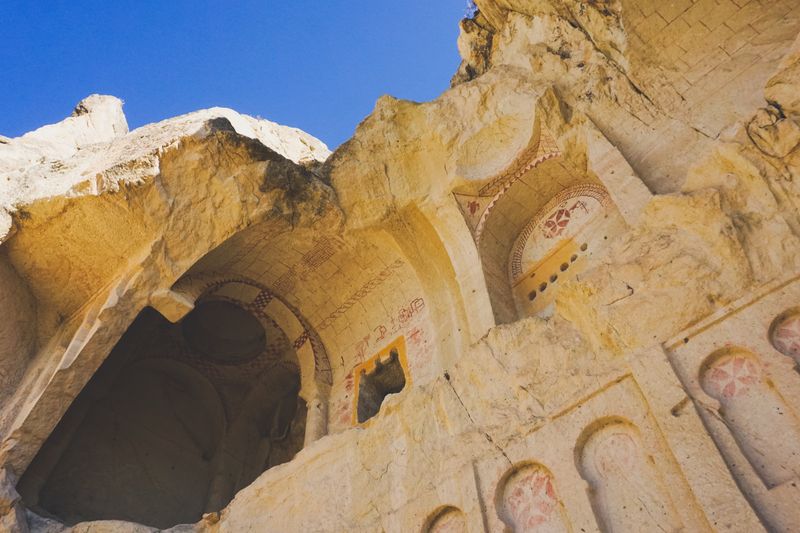
During the Byzantine period, numerous churches, monasteries, chapels, and religious communities were established throughout Cappadocia. The soft volcanic rock allowed religious communities to carve entire complexes into the landscape. Many of these churches were decorated with beautiful frescoes depicting scenes from the Bible, the life of Jesus Christ, the Virgin Mary, and important Christian saints. The Göreme Open-Air Museum is one of the finest examples of this extraordinary religious architecture. Some of the most famous churches include: Tokalı Church: Famous for its extensive Byzantine frescoes depicting scenes from the life of Christ. Apple Church (Elmalı Kilise): Known for its biblical scenes and religious paintings. Dark Church (Karanlık Kilise): Particularly famous for its exceptionally well-preserved frescoes. Saint Barbara Church: Recognized for its geometric decorations and religious symbols. These churches provide an extraordinary insight into Byzantine art, religious traditions, and monastic life in medieval Anatolia. The Underground Cities of Cappadocia: Derinkuyu and Kaymaklı One of the most remarkable features of Cappadocia is its extensive underground architecture. The underground cities of Derinkuyu and Kaymaklı are among the most impressive examples. These settlements contain multiple levels connected by narrow passages, stairways, ventilation shafts, and stone doors. Inside the underground cities, visitors can discover: Living quarters Kitchens and food storage rooms Wine production areas Animal shelters Water wells Religious spaces Ventilation systems
But why did people build underground cities?
The main reasons were protection and security. During periods of military conflict and invasions, local communities could take shelter underground to protect themselves and their families. These underground settlements were particularly important during periods of Arab-Byzantine warfare from the seventh century onward. Although some underground structures may have earlier origins, the existing complexes were developed and expanded over many centuries. The Iconoclast Period and Byzantine Religious Art Between the eighth and ninth centuries, the Byzantine Empire experienced a major religious controversy known as Iconoclasm. The debate concerned the use of religious images and icons representing Jesus Christ, the Virgin Mary, and Christian saints. During this period, some Byzantine emperors opposed the use of religious images, resulting in the destruction or removal of numerous religious paintings. The effects of this controversy can still be observed in some churches throughout Cappadocia, where simple crosses and geometric decorations replaced more elaborate religious imagery. In AD 843, the restoration of the veneration of icons marked an important turning point in Byzantine religious art. Following this period, many churches in Cappadocia received elaborate fresco decorations, some of which remain remarkably well preserved today.
6. The Battle of Manzikert in 1071 and the Arrival of the Turks
In 1071, the Seljuk Sultan Alp Arslan defeated the Byzantine Emperor Romanos IV Diogenes at the Battle of Manzikert. This battle became one of the most important turning points in the history of Anatolia. Following the Seljuk victory, Turkish settlement in Anatolia gradually increased, and Cappadocia eventually came under Seljuk control. However, the region's Christian population and religious traditions did not disappear immediately. Many churches and monasteries continued to be used for centuries. During the Seljuk period, Cappadocia also remained connected to important commercial routes crossing Anatolia. This period introduced another important cultural layer to the region's already rich historical heritage.
7. Cappadocia Today: A UNESCO World Heritage Site
In 1985, Göreme National Park and the Rock Sites of Cappadocia were added to the UNESCO World Heritage List. The region was recognized for its outstanding natural and cultural significance. Its unique combination of geological formations, underground settlements, Byzantine churches, monasteries, and historical architecture makes Cappadocia one of the most extraordinary destinations in Turkey. Today, visitors can explore the remains of different civilizations while discovering the natural beauty of the region. The UNESCO designation recognizes the importance of preserving this exceptional cultural landscape for future generations.
Discover Thousands of Years of History in Cappadocia
Cappadocia is much more than a destination famous for hot-air balloons and fairy chimneys. It is a region where thousands of years of Anatolian history can be discovered through ancient settlements, underground cities, Roman heritage, and Byzantine religious architecture. From the Hittites and Persians to the Romans and Byzantines, each civilization contributed to the unique identity of Cappadocia. Whether you explore the underground city of Derinkuyu, admire the frescoes of the Göreme Open-Air Museum, or walk through the historical landscapes of Ihlara Valley, you will experience a remarkable connection between nature, history, and human civilization. Cappadocia is truly an open-air museum where millions of years of geological history meet thousands of years of human civilization. If you want to understand the history of Anatolia, Cappadocia is one of the most fascinating places to begin your journey.
Last Modification : 11/24/2026 8:28:12 AM